The recession has hit everyone, including bike makers. However, times are especially tight for auto makers, who have seen their sales plummet enough that there were more bikes sold in the first quarter of this year (2.6 million) than cars (2.5 million).
Not bad. With gas headed back up (2.50 and rising) pedal power is the way to go. Especially since it hasn't rained here for a month (okay, we do need the rain).
04 June 2009


03 June 2009
What's your Walkscore?
According to the website Walkscore.com, ours is 98. Well, for two of our cars, anyway. #6 and #10 score 98 out of a possible 100. The rest of the HOURCAR fleet range as low as 66.
The average for the whole fleet is 87, meaning that we are "very walkable" and close to a "walker's paradise" overall. Of course, the site has its limitations: directions are as the crow flies and it sometimes misses certain stores in categories (like, you know, the Wedge and Mississippi Market Coops in "grocery stores").
They recently ranked the 40 largest cities (*) in the country (since Minneapolis and Saint Paul are separate, neither made the cut; an oversight on Walkscore's part) and the winner was San Francisco, which scores an eminently walkable 86, followed by New York, Boston and Chicago. (They have some pretty nice maps, too.) So, does that mean that HOURCAR is more walkable than San Francisco? Discuss.
(*) Why they did this I do not know. More pertinent would have been the central cities of the 40 largest metro areas in the country. But their methodology is their methodology (and, hey, it says almost nothing about access to jobs, which is probably the most important aspect of a location); perhaps it would make sense to contact them and tell them to please rank the Twin Cities, if only because we'd find it interesting.
The average for the whole fleet is 87, meaning that we are "very walkable" and close to a "walker's paradise" overall. Of course, the site has its limitations: directions are as the crow flies and it sometimes misses certain stores in categories (like, you know, the Wedge and Mississippi Market Coops in "grocery stores").
They recently ranked the 40 largest cities (*) in the country (since Minneapolis and Saint Paul are separate, neither made the cut; an oversight on Walkscore's part) and the winner was San Francisco, which scores an eminently walkable 86, followed by New York, Boston and Chicago. (They have some pretty nice maps, too.) So, does that mean that HOURCAR is more walkable than San Francisco? Discuss.
(*) Why they did this I do not know. More pertinent would have been the central cities of the 40 largest metro areas in the country. But their methodology is their methodology (and, hey, it says almost nothing about access to jobs, which is probably the most important aspect of a location); perhaps it would make sense to contact them and tell them to please rank the Twin Cities, if only because we'd find it interesting.
11 May 2009
Smart planning and smart savings ($9400!)
Here are two sweet articles which have crossed our desk.
First, you all might want to drive the HOURCAR more since, according to the American Public Transit Association, you're saving money versus owning a car. A lot of money. I mean, we knew that you'd save, but $9407 a year? Wow. Yeah, if you drive a long distance and pay $200 a month for parking, it will cost.
$9407 is a lot of money. It's a pretty sweet vacation. Or three. It's $180 a week, twenty-six bucks a day. According to APTA, you could drive the HOURCAR three or four times a day and still come out ahead. That's a pretty damn good deal.
******
Second, from the Times comes a story about car-free suburbs in Germany. We like good development, and we like car-free.
Wave of the future, folks, wave of the future!
First, you all might want to drive the HOURCAR more since, according to the American Public Transit Association, you're saving money versus owning a car. A lot of money. I mean, we knew that you'd save, but $9407 a year? Wow. Yeah, if you drive a long distance and pay $200 a month for parking, it will cost.
$9407 is a lot of money. It's a pretty sweet vacation. Or three. It's $180 a week, twenty-six bucks a day. According to APTA, you could drive the HOURCAR three or four times a day and still come out ahead. That's a pretty damn good deal.
******
Second, from the Times comes a story about car-free suburbs in Germany. We like good development, and we like car-free.
Street parking, driveways and home garages are generally forbidden in this experimental new district on the outskirts of Freiburg, near the French and Swiss borders. Vauban’s streets are completely “car-free” — except the main thoroughfare, where the tram to downtown Freiburg runs, and a few streets on one edge of the community. Car ownership is allowed, but there are only two places to park — large garages at the edge of the development, where a car owner buys a space, for $40,000, along with a home.That's pretty cool. If you make car ownership difficult and expensive, people will turn to cleaner, greener options.
As a result, 70 percent of Vauban’s families do not own cars, and 57 percent sold a car to move here.Hey, this is about the same proportions as the HOURCAR membership base.
“When I had a car I was always tense. I’m much happier this way,” said Heidrun Walter, a media trainer and mother of two, as she walked verdant streets where the swish of bicycles and the chatter of wandering children drown out the occasional distant motor.Now, if only we could have Minneapolis sound the same way (you know, other than the Greenway).
Vauban, home to 5,500 residents within a rectangular square mile, may be the most advanced experiment in low-car suburban life.And, maybe, we can get there. Minneapolis's population density is 6,700 and Saint Paul's is 5,400. Not the highest around (66,000 in Manhattan) but not bad.
For trips to stores like Ikea or the ski slopes, families buy cars together or use communal cars rented out by Vauban’s car-sharing club.And, yes, they do have car sharing (of course!).
Wave of the future, folks, wave of the future!
29 April 2009
That's not Green we can believe in
Perhaps you read Failblog and noticed a "Going Green Fail" they posted. Well, it's below:

Oh, that is so wrong on so many levels I won't even start. Eco Smart makes energy saving products like tankless water heaters which actually do save energy. But to plaster their name on a Hummer? Poor form, guys, poor form.
Of course, someone presciently pointed out that (877) 47 GO GREEN truncates to (877) 474-OGRE. So if you want a water heater, just dial the Hummer-driving ogres as Eco-Smart.

Oh, that is so wrong on so many levels I won't even start. Eco Smart makes energy saving products like tankless water heaters which actually do save energy. But to plaster their name on a Hummer? Poor form, guys, poor form.
Of course, someone presciently pointed out that (877) 47 GO GREEN truncates to (877) 474-OGRE. So if you want a water heater, just dial the Hummer-driving ogres as Eco-Smart.
19 April 2009
Who else doesn't own a car?
Two top Obama administration officials, it turns out. In today's New York Times, we find out that Ezekiel Emanuel and Secretary of Energy Steven Chu don't own cars (although Chu is now forced to be driven around by a security detail, and he "doesn't feel good about it.")
No word on if they are car sharers, but when our leaders eschew car ownership, perhaps times are a-changin'.


By the way, the Magazine this week is themed as the Green Issue, and it's a pretty good read.
And, yes, Emanuel is the brother of Chief of Staff, Rahm. Their other brother, Ari, the basis for Ari Gold on the teevee show Entourage, graduated from Macalester College, which is, of course, an HOURCAR Hub.
No word on if they are car sharers, but when our leaders eschew car ownership, perhaps times are a-changin'.


By the way, the Magazine this week is themed as the Green Issue, and it's a pretty good read.
And, yes, Emanuel is the brother of Chief of Staff, Rahm. Their other brother, Ari, the basis for Ari Gold on the teevee show Entourage, graduated from Macalester College, which is, of course, an HOURCAR Hub.
02 April 2009
Driving hybrid
There's an interesting story on NPR this morning (perhaps you heard it? It seems a lot of our cars are tuned to NPR.) about how driving style matters—a lot—when you are driving a plug-in hybrid.
The two solar-powered plug-in hybrid HOURCARs are of a similar (if not the same) design, and how you drive them definitely makes a big difference. If you take them out on the freeway at 75 mph, drive with jackrabbit starts, or are a complete leadfoot, your mileage will likely be subpar. If you drive them gently, accelerate slowly, and do your best to not engage the gas engine (especially at speeds below 42 mph—when the gas engine spins up no matter), you'll do better.
And, of course, every Prius in the HOURCAR fleet has a nifty screen which lets you know how efficiently you drive. (Consensus is that if these were mandated in every car in the country, fuel consumption would decline appreciably.) Next time you're out in a car, reset the mileage, and when you are done, if you have driven well, send us a picture of the screen with the great milage and we'll post it here. I'd say we'd give the best mileage a free t-shirt but … all of our members already get t-shirts!
"Oh-oh. You see that heavy foot right there? You just got the gas motor to come on at 20 miles an hour," she says.
That's a total no-no if you want to get the most miles per gallon. You want to rely on the battery and keep the gas motor off. At 20 mph, there's no reason for it to kick in — unless you have a heavy foot, which, apparently, I do.
"There's no need to just kind of punch it. It'll go," Fahenstock says. "You're really not going to get to your destination any sooner. Why do you need to accelerate so quickly?"
The two solar-powered plug-in hybrid HOURCARs are of a similar (if not the same) design, and how you drive them definitely makes a big difference. If you take them out on the freeway at 75 mph, drive with jackrabbit starts, or are a complete leadfoot, your mileage will likely be subpar. If you drive them gently, accelerate slowly, and do your best to not engage the gas engine (especially at speeds below 42 mph—when the gas engine spins up no matter), you'll do better.
And, of course, every Prius in the HOURCAR fleet has a nifty screen which lets you know how efficiently you drive. (Consensus is that if these were mandated in every car in the country, fuel consumption would decline appreciably.) Next time you're out in a car, reset the mileage, and when you are done, if you have driven well, send us a picture of the screen with the great milage and we'll post it here. I'd say we'd give the best mileage a free t-shirt but … all of our members already get t-shirts!
24 March 2009
Cars you will not see in the HOURCAR fleet
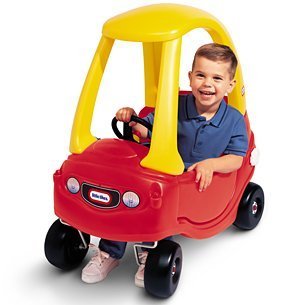
We read, as I'm sure many of you did, about the Tata Nano in the New York Times. It's a small car, gets decent mileage (although emissions are not great, to reach the $2000 price tag things like a catalytic converter are more expendable), and lacks amenities like power steering and airbags and wheels larger than "dinner plates." We weren't chomping at the bit to grab one but were further deterred when one of our staff made the following comparison to another cutesily-named car, the Cozy Coupe II:


Uncanny.

Uncanny.
Subscribe to:
Posts (Atom)